Germany has reached a new low in election rigging

Today’s Germany is a grim, unhappy place. Thirty-six years after West Germany’s take-over of the former East Germany (polite term: re-unification), which was supposed to herald a golden age of national fulfilment, citizens are in a very foul mood.
According to Ipsos, one of Germany’s go-to pollsters, their morale is at a “historic nadir,” and they are “losing confidence about the country’s future.” As of last month, fear of poverty and inequality was “clearly increasing,” with 37 percent of all respondents picking it as their number-one angst, followed by “migration” (31 percent), “inflation” (30 percent), worries over the healthcare system (26 percent) and “criminality and violence” (25 percent).
Note that all top five anxieties focus on what is going wrong at home. That doesn’t mean, though, that Germans are optimistic about the world or Germany’s place in it: 24 percent of the Ipsos poll respondents fear “military conflicts between states.”
If the mood is sour, it’s very good reasons: Germany’s abysmally, unprecedentedly unpopular and embattled chancellor, Friedrich Merz, is desperately trying to sell an absurd feel-good story about the German economy as an “anchor of stability.” But that only demonstrates how divorced from reality Germany’s rulers are: In the real Germany that their subjects must inhabit, industrial output is 17 percent below 2017. After the recent roll-out of a perfectly underwhelming “reform package,” business leaders have warned that much more is needed to prevent a “lost decade.” That would be, in effect, the second one in a row.
Meanwhile, Berlin is busy doing two things: cut down public spending on absolutely vital things such as education (next to inexpensive energy, the decisive resource for Germany’s prosperity already sacrificed to the proxy war against Russia) and raze the sorry remnants of social safety nets that have long been in tatters already.
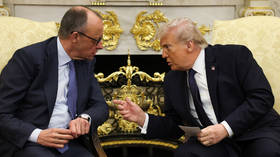
That doesn’t mean Germany is not going into catastrophic debt. It is, as if there’s no tomorrow. The money is flowing in torrents. Just not for Germany’s citizens and tax payers but for Zelensky-regime Ukraine (to the tune of, officially, almost €100 billion and counting) and for an insane armament drive that signals a very unhealthy – if historically repetitive – urge to go to war with Russia. This year, €83 billion is earmarked for weapons; next year it will be €110 billion. And so on: €154 billion for 2028, €163 billion for 2029, and a grand crescendo with €184 billion in 2030.
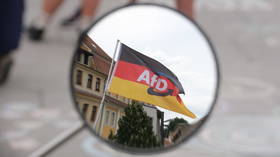
This is the background of not only a severe national depression but also a search for alternatives. At this point at least, the AfD (Alternative for Germany), an anti-immigration party founded in 2013, is benefiting the most from this crisis. On the rise for roughly a decade now, its momentum has recently greatly accelerated.
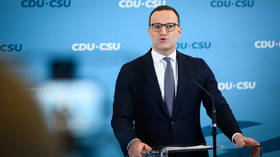
A fresh poll for all of Germany has the AfD at 27 percent, outdistancing (again) all other parties, including those making up the radical-Centrist coalition currently in charge in Berlin (CDU – 21 percent, SPD – 12 percent).
Perhaps even more importantly, the AfD may well win crucial regional elections in the key eastern Land of Saxony-Anhalt and looks set to do very well in two others – in Mecklenburg-Vorpommern and Berlin – as well.
In sum, the AfD is probably on the verge of a historic breakthrough that will greatly weaken, maybe even ruin the traditional parties’ longstanding “firewall” strategy of freezing it out of political leadership positions no matter what the people say in elections, in effect half-disenfranchising its voters.
This moment is likely to reset the whole German political system at the cost of the establishment parties which are still desperately defending their de facto exclusive hold over political offices, perks, and power.
So, what do you do when you are losing a (barely) fair fight? Easy, at least if you are part of Germany’s self-appointed guardians of democracy, civil society, and wholesome ‘values’ all around: You start playing even dirtier.

In the case of the threat the AfD poses to Germany’s establishment parties, the latter have always toyed with this option: Would it not be just oh-so-convenient to simply prohibit such a troublesome competitor under the pretext that it is so radical and dangerous it does not deserve a fair chance? The perverse dream of ‘saving’ what’s left of German democracy by abolishing the biggest opposition party is by no means dead. Some die-hard Centrist radicals, intriguingly including Germany’s militarist-in-chief minister of defense Boris Pistorius, can’t let go of it.
This has all been accompanied by a mainstream media cacophony of cries of “democracy in danger!” and “Nazis at the gates!” Crazy conspiracy theories included, such as the one recently spread – without being challenged – by a member of the co-ruling SPD party on a mainstream news channel: Let’s just blame the latest Islamist terror attack in Berlin on Russia trying to boost the AfD. In what alternative universe does that make any sense? Welcome to the often unhinged, notoriously shameless, and very ugly world of German mainstream discourse.
The problem with the let’s-just-prohibit-the-whole-lot approach is that having a party banned is, fortunately, very hard under German law. And although Berlin’s establishment parties don’t mind bending the rules to deploy nasty lawfare, they do want to be sure to win. If they try to prohibit the AfD and fail, the latter will only get even stronger, as everyone understands. Indeed, even prohibiting ‘merely’ a part of a party, say, a Land organization, is neither easy nor a sure bet.
But what if there were a way to kneecap the AfD without having to run that risk? What about, for instance, promising AfD candidates could be taken out and removed from elections without having to overcome the high legal hurdles that make full-fledged prohibition so scary? And that is where the Land of Lower Saxony (in the former West Germany and not to be confused with Saxony-Anhalt in the former East Germany) has taken on the role of trailblazer in democracy defense via democracy suppression.
Think of recent events there as a prototype or trial balloon. Based on a very recently passed, as it were, made-to-measure law, local election committees have begun to block AfD candidates from running by invoking especially produced reports from the Land branch of Germany’s domestic intelligence service, the Verfassungsschutz. This is unprecedented and scandalous, as critics are pointing out. In a ludicrously flimsy and absurdly unfair procedure that needs no courts – in this manner similar to EU sanctions-against-dissidents policy – German citizens are deprived of the passive franchise, the right to be elected.
In the past, such a severe curtailing of elementary democratic rights was tied to having committed – and been properly sentenced for – substantial crimes. Now an intelligence report’s ‘recommendation’ and a simple show of hands in a very local committee suffice. No court, no effective possibility of defense or reasonably quick appeal, and, really, no law worth the term. This is administrative fiat masquerading as legal process.
The election committees are – surprise, surprise – staffed with preponderant majorities of establishment party representatives, while the domestic intelligence offices producing the reports the committees use – de facto indictments – are subordinate to the Land interior ministry which is led by SPD politician Daniela Behrens, who seems very proud of her contribution to shutting down what she considers excessive choice in elections. Indeed, her ministry has circulated an internal memorandum, in essence, to stimulate the removal of AfD candidates by laying out wide and flexible criteria: See how easy that is? Now get going!
These criteria – or perhaps rather pretexts – for this regime of preventative electoral exclusion include membership in the AfD. Yes, you have read that right: Being a member of the party for which you are trying to run, while that party has not been prohibited and probably never will be, is already a reason for being kicked out of the elections.
Not, at least pro forma, a sufficient reason, it is true. Other truly weighty things must be added. Such as, for instance, a social media post that insists that “real democrats have no need to prohibit other parties” and calls on readers to “stand together for freedom of opinion and against dictatorship.” Yes, you have read that right as well.
By now, a handful of AfD candidates for local office – including a current member of the federal parliament in Berlin – have been dealt with in this new, innovative manner. They are likely to seek legal recourse against this Kafkaesque caricature of due process, but things have been set up in such a way that that may well take years, while the elections will, meanwhile, go ahead in their truncated format.
Full disclosure: I have very little political sympathy for the AfD. But I do take democracy seriously. If the scandalous radical-Centrist attack on election integrity tried out now in one Land becomes a model for the rest of Germany, then those pretending to defend democracy will have put yet another nail in its coffin.
The statements, views and opinions expressed in this column are solely those of the author and do not necessarily represent those of RT.